[WIA Languages Day 34/221] Piedmontese – The Voice Remembered by Alpine Vineyards
WIA LANGUAGES PROJECT
[Day 34/221]
Piedmontese
Piedmontese | Piemontèis
“The Voice Remembered by Alpine Vineyards”
A quiet revolution, 221 languages’ digital archive • We’re not saving languages. We’re recording eternity.
“Dësgusta mach ël vin
ch’a l’ha nen ëd poesia
e parla mach la lenga
ch’a l’ha nen ëd malinconia.”
[des-GOO-stah mahk el veen / kah lah nen ed poh-eh-ZEE-ah / eh PAR-lah mahk lah LEN-gah / kah lah nen ed mah-leen-koh-NEE-ah]
“Only drink wine
that has no poetry in it
and only speak a language
that has no longing in it.”
— A traditional Piedmontese proverb. Good wine carries poetry, and a true language carries longing. For the Piedmontese, language and wine are the same thing.
Every 14 days, a language falls silent on Earth. Before the echoes of yesterday’s Lombard have faded, today we journey to the western slopes of the Alps. The homeland of Barolo and Barbaresco wines, the land that cradles Turin. Approximately 2 million people still love and sing in this tongue. Yet schools don’t teach it, and the young are gradually forgetting. Today, we encounter the soul of Piedmontese (Piemontèis).
History – From Roman Province to the Court of Savoy
Piedmontese traces its roots to the Celtic-Ligurian tribes who settled on the western slopes of the Alps. The Romans conquered this region, but the natural barriers created by the mountainous terrain allowed the local Latin to evolve independently. Influenced by French and Occitan, it walked an entirely different path from the other languages of the Italian peninsula.
By the 12th century, Piedmontese began to blossom as a literary language. It served as the administrative language of the House of Savoy, and in the 18th century, the great poet Edoardo Calvo wrote his verses in Piedmontese. Even Camillo Cavour, the father of Italian unification, spoke Piedmontese in his daily life. When Turin was Italy’s first capital, the court’s official languages were not Italian but Piedmontese and French.
But history dealt an ironic blow. Piedmont, which led Italian unification, began losing its own language after unification was achieved. The new nation imposed Standard Italian based on the Tuscan dialect, and Piedmontese was demoted to a mere “dialect.” The language that built a nation was pushed aside by that very nation.
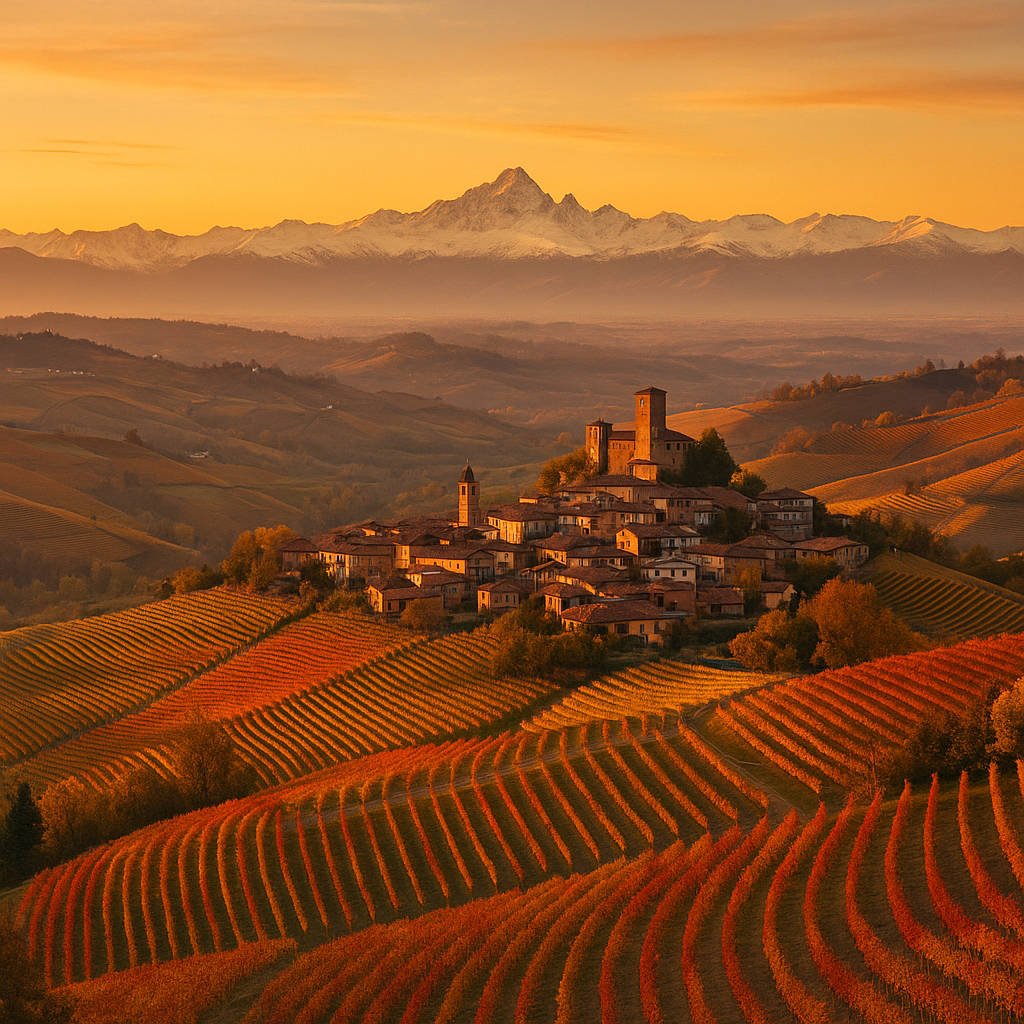
[The Korean Today] Vineyard landscape of Piedmont at the western foot of the Alps, where autumn hills and medieval villages blend together © The Korean Today Editorial
Present Day – The Quiet Resistance of 2 Million Speakers
As of 2025, approximately 2 million people speak Piedmontese. UNESCO classifies it as “definitely endangered.” The Italian government still does not recognize it as an official language. Yet the resistance of the Piedmontese people is quiet but powerful.
Piedmontese has only about 50% mutual intelligibility with Italian. This is evidence that it is not a “dialect” but an independent language. Compare this with Spanish and Portuguese (89% mutual intelligibility), and you can see just how different Piedmontese is from Italian. Yet it is still dismissed as a “dialect.”
Hope came from the digital world. The Piedmontese Wikipedia contains over 60,000 articles — more than many “official languages” can claim. Online communities actively share Piedmontese literature, music, and theater. Among the younger generation, some are beginning to reclaim their grandparents’ language.
Linguistic Treasures – Wisdom of the Vineyards
Piedmontese is exceptionally rich in expressions about grapes and wine. “Ël vin a l’é la tëta dël pòver” [el veen ah leh lah TET-ah del POH-ver] — “Wine is the milk of the poor.” In Piedmont, wine is not merely a beverage but a part of life itself, the thread that weaves communities together.
Piedmontese’s most distinctive features are its nasalized vowels and the ‘ë’ (schwa) sound, similar to French. These sounds, absent in Italian, give Piedmontese a soft, musical resonance. “Bonjorn, coma staje?” [bon-ZHORN, KOH-mah STAH-zheh?] — “Hello, how are you?” Even in this simple greeting, the French influence is palpable.
WIA’s Promise – A Digital Archive Aging Like Barolo
WIA digitally preserves Piedmontese literary heritage for eternity. From 18th-century poetry collections by Edoardo Calvo to works by contemporary Piedmontese playwrights. From the grape harvest songs once sung by farmers in the Langhe hills to the Piedmontese ballads that echoed through Turin’s cafes. Everything is being transformed into high-resolution digital archives.
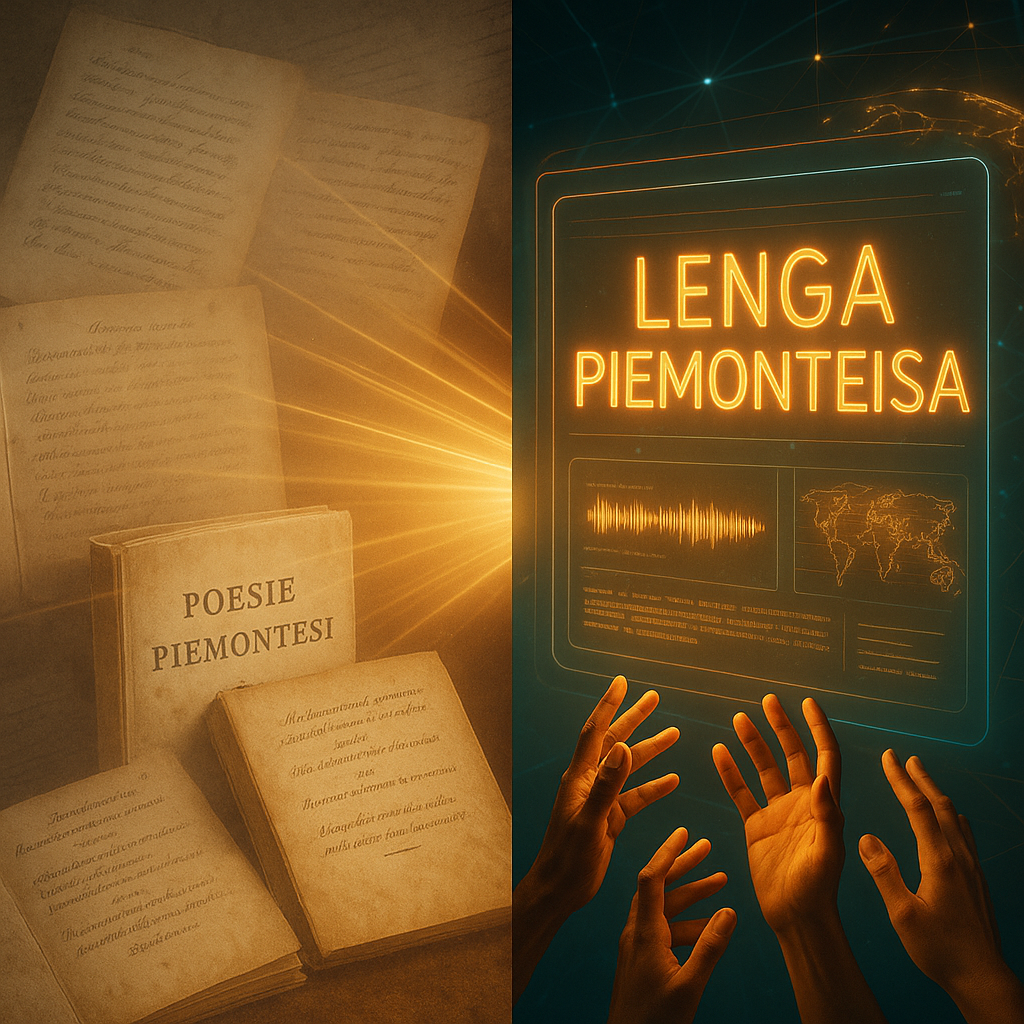
[The Korean Today] The moment where Piedmontese past meets its digital future © The Korean Today Editorial
A fine Barolo wine requires decades of aging to reach perfection. WIA’s digital archive works the same way. Its value deepens with time. A hundred years from now, two hundred years from now, someone will open this archive and hear the sounds of Piedmontese. The songs of the vineyards will echo forever.
“Che Nosgnor at bëdda
e at daga sempe da mangé e da bèive.”
[keh nohs-NYOR aht BED-ah / eh aht DAH-gah SEM-peh dah mahn-ZHEH eh dah BAY-veh]
“May the Lord bless you
and always give you food and drink.”
— Traditional Piedmontese table blessing
221 languages. 221 days. Today, the voice of Piedmontese crosses the vineyards at the western foot of the Alps to reach your heart. Deep and rich as Barolo wine, this language refuses to fall silent. In digital archives, in the songs of the vineyards, within WIA’s records — it shines eternally.
This quiet journey we began will resonate across millions of hearts, echoing through generations.
With WIA, every voice is eternal.
WIA Language Institute
221 Languages – Recording Languages for Eternity
© 2025 WIA Language Institute. All rights reserved.
#WIA_Languages #Piedmontese #Piemontèis #EndangeredLanguage #LanguagePreservation #DigitalArchive #UNESCO #Alps #Italy #WIA
<저작권자 ⓒ 코리안투데이(The Korean Today) 무단전재 및 재배포 금지>