
[Day 43] A Sigh on the Road to Xuzhou
March · *The Woman Beneath the Moonlight* | about 3 min read
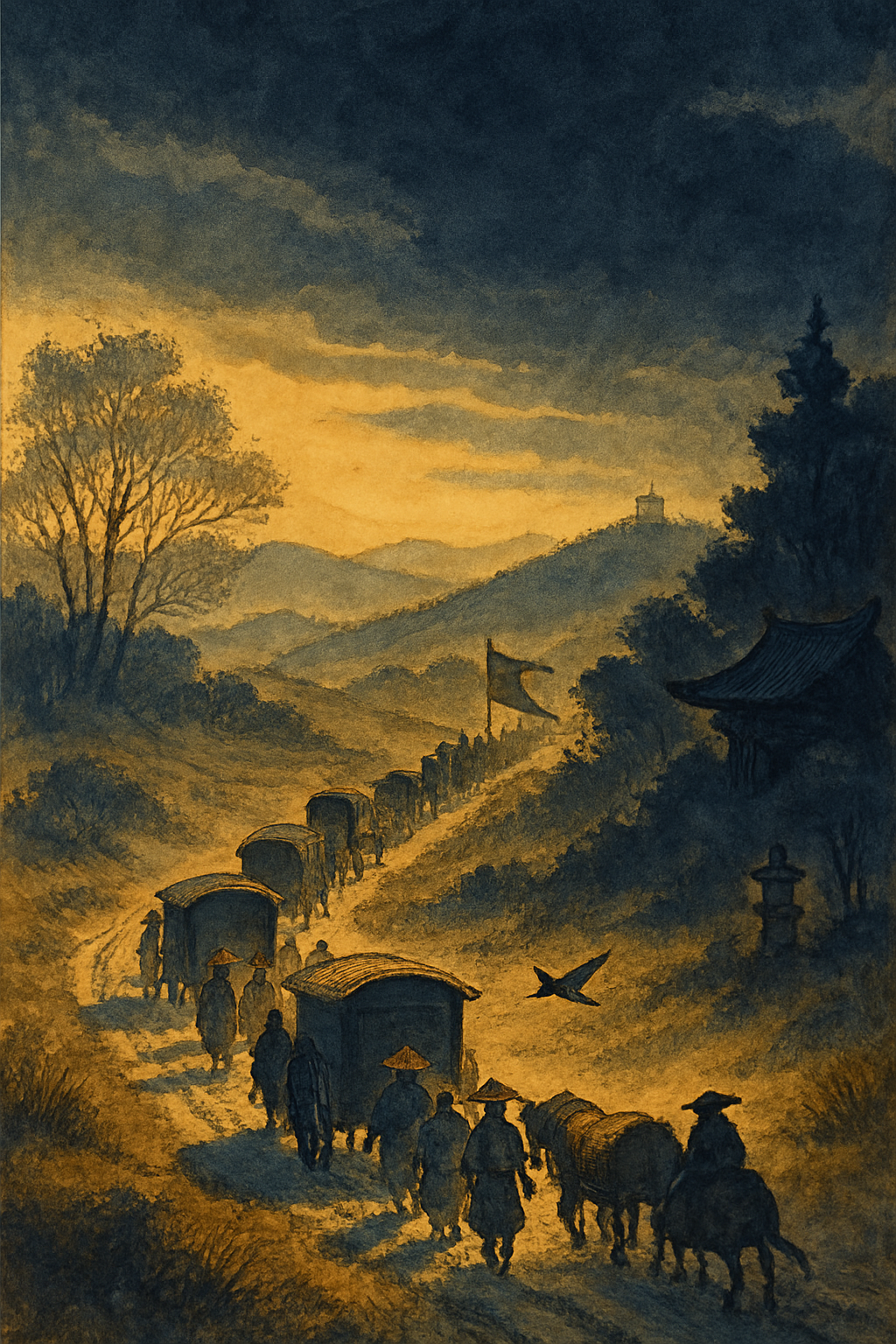
As the fires of Chang'an were settling, far to the east at Yanzhou (兗州) one man's father's name was crossing toward Xuzhou (徐州) on a long breath.
Cao Cao of Yanzhou, over the past year, had taken some three hundred thousand Qingzhou (靑州) Yellow Turban men as a body of crack soldiers, and had raised his fame greatly across Shandong (山東). Before his tent, civil ministers and military captains walked in one by one. Xun Yu (荀彧) of Yingchuan (穎川) and his nephew Xun You (荀攸); Cheng Yu (程昱) of Dong'a; Guo Jia (郭嘉) of Yingchuan; Liu Ye (劉曄) of Huainan; Man Chong (滿寵) of Shanyang; Lü Qian (呂虔) of Wucheng; Mao Jie (毛玠) of Chenliu. Eight names knelt in a single line under the sunlight before the tent that day.
One day Xiahou Dun (夏侯惇) brought in a large man. Tall, broad in the shoulders, with a pair of iron halberds swinging heavy on his back. It was Dian Wei (典韋), a man of Chenliu. Cao Cao weighed the paired halberds in his hand and laughed greatly. "This man is the Wulai (惡來) of old times."
Shortly after, Cao Cao gave a low order. "Send Ying Shao (應劭), grand administrator of Taishan. Let him escort my father Cao Song (曹嵩) — who dwells in Langye (瑯琊) — to Yanzhou." Cao Song had, in former days, fled the trouble of Chenliu and settled deep in the woods of Langye. Upon receiving his son's letter, he set out toward Yanzhou with his younger brother Cao De, some forty household members of all ages, about a hundred retainers, and some hundred carts of baggage.
The road happened to pass through Xuzhou (徐州). Tao Qian (陶謙), grand administrator of Xuzhou, was by nature warm and honest. He had long sought a tie with Cao Cao without finding the way; hearing that Cao's father was passing his territory, he prepared a great welcome. He went himself to the border of Xuzhou to greet them, made repeated bows, and held a great banquet, lodging them two days.
On the morning of the third day, Cao Song bade farewell to Tao Qian. Tao Qian put his officer Zhang Kai (張闓) in charge of five hundred soldiers for the escort. Zhang Kai had originally been a remnant of the Yellow Turbans; Tao Qian had taken him up as a Xuzhou officer out of kindness, believing that a man who had once carried a yellow kerchief could learn in time to carry a lawful banner. Yet within that eye, the greed of his former Yellow Turban days still remained, and Tao Qian, whose kindness could read many faces, had never learned how to read this one.
When Cao Song's party reached the border of the two counties of Hua (華) and Fei (費), a great rain fell. The company entered an old temple by the road to take shelter. Zhang Kai gave a low order to the five hundred. "Those hundred carts of baggage are full of gold, jade, and silk. Tonight cut them all down in this temple. We take the baggage among ourselves and flee to Yuan Shu (袁術) in Huainan."

That night, within the old temple, a blade came down upon Cao Song's neck. Cao Song, Cao De, forty of the household, and a hundred retainers fell together. Zhang Kai loaded a hundred carts and fled with five hundred soldiers toward Huainan.
Ying Shao heard the matter late and, fearing to report to Cao Cao, fled to Yuan Shao's (袁紹) camp. A single retainer alone managed to live, and rode hard toward Yanzhou.
At the center of Yanzhou's tent, Cao Cao received the report. A breath of silence. At the next breath, blood gathered long inside his two eyes. Within those tears, a grain of rage hardened into the grain of a blade. "Tao Qian. This grudge I shall write in blood upon the walls of Xuzhou."
Xun Yu, standing behind him, offered no line of counsel for a long while. A counselor knows when a master's grief has not yet turned into a matter upon which counsel can sit. He only stepped back, quietly, one pace. In the days to come, Xun Yu would bring forth his careful lines about what harm a revenge-campaign could do to Yanzhou's newly gathered grain of rule; but not tonight. Tonight the air of the tent belonged to a son's unanswered two eyes.
Elsewhere, at the altar of Cao Song, a single lamp was lit, and would not be moved by any hand for a long time to come. The grain of that small lamp was smaller than any seat in a great general's campaign map; yet it was the lamp by which every map drawn this season would be read. A son's map drawn by an altar's lamp is a map harder to fold than any other map of the season.
The thirteenth evening of Book 2 deepened, quietly, across two seats: the center of the Yanzhou tent and the old temple in the two counties of Hua and Fei. The three characters Buuntodo (父殞途, the seat where a father fell upon the road) were planted as a seed: the breath upon which a father's name fell upon the road to Xuzhou. The leap of a Minister in Day 42's Seonpyeongtu and tonight's fall of a father at the old temple lay side by side upon the same manner of an end.
—

“✒️ A Word from the Commentator — Dr. Yeon Samheum
There is an evening on which a father's name falls within an old temple upon a road. The breath of that fall gathers into blood inside a son's two eyes. Behind your own father's name, is there perhaps the length of a fallen breath? Might you look, quietly, into the weave of that length?
<저작권자 ⓒ 코리안투데이(The Korean Today) 무단전재 및 재배포 금지>


















