
[Day 49] The Carriage to Luoyang
March · *The Woman Beneath the Moonlight* | about 3 min read
Li Jue (李傕) and Guo Si (郭汜) of Chang'an began to fight each other in a spring two years after Wang Yun's leap. Each coveted a larger share of the court's power. Li Jue seized Emperor Xian (獻帝) and kept him in the Northern Camp; Guo Si seized the ministers and kept them in the Southern Camp. Upon the streets of Chang'an, the spears of the two camps met each day, and the count of killed and wounded rose daily.
After some months, the two grew weary of each other and came to a reconciliation. Emperor Xian was barely released from both camps. Among the ministers, Yang Feng (楊奉), Han Xian (韓暹), and Dong Cheng (董承) escorted the imperial carriage and began moving eastward. The direction of the carriage was Luoyang.
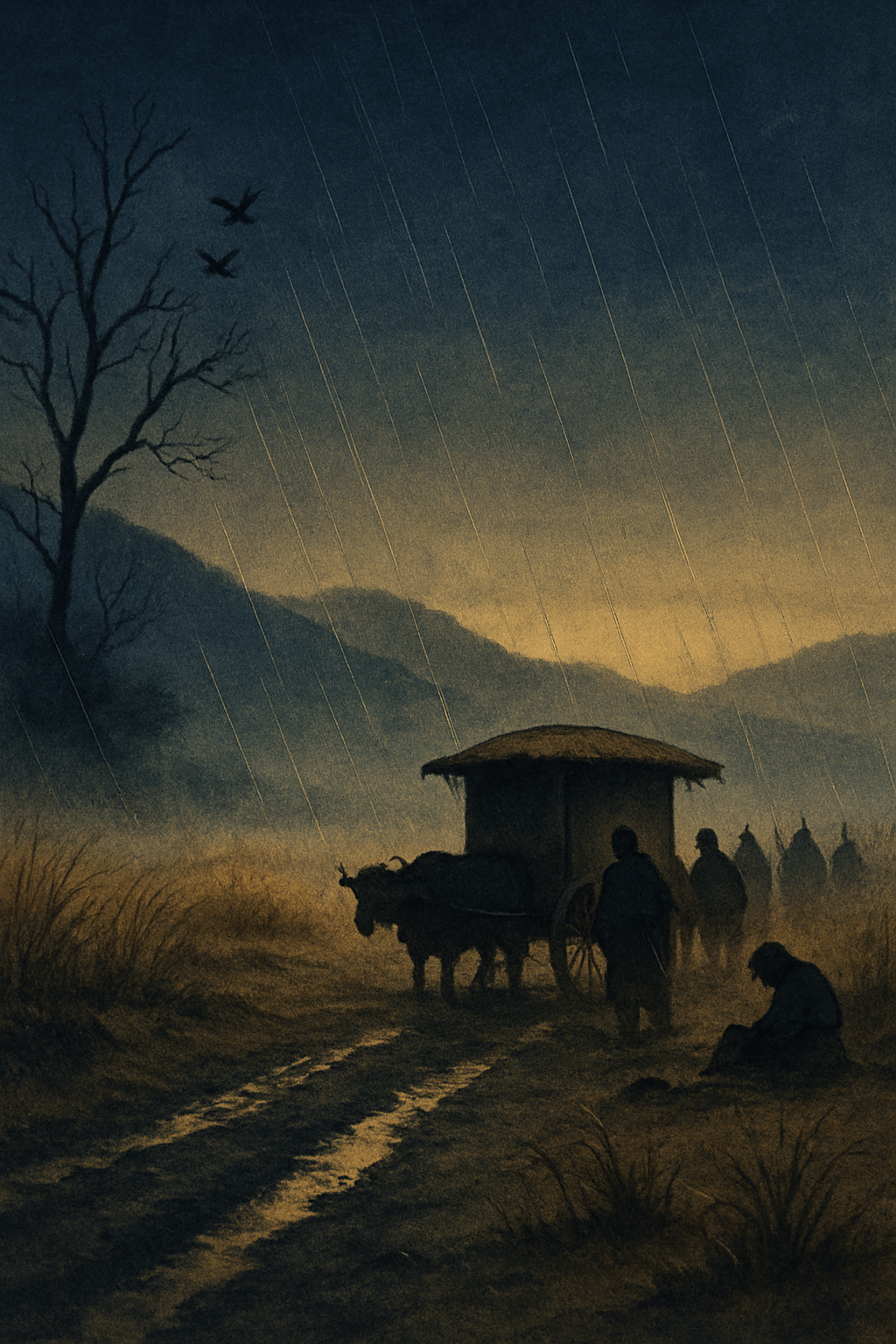
The road of the imperial carriage was long and hard. Eight hundred li lay between Chang'an and Luoyang, and upon that road famine and rain took turns. Emperor Xian and the Empress sat upon the carriage. Both their clothes had grown worn, and many days came when not one proper meal could be taken.
Li Jue and Guo Si realized, too late, that they had been cheated of the carriage. The two gathered their armies again and pursued. Yang Feng and Han Xian took turns blocking the rear, engaging daily. At the carriage's head, Dong Cheng opened the road. There were many evenings when the carriage's wheel did not move even fifty li in a day.

Passing Hongnong (弘農) and reaching Xinfeng (新豐), half of the carriage's soldiers were lost to famine. The robes of the hundred officials became rags, and there were several evenings when the carriage's wheel sank into mud and could not be pulled out. Emperor Xian looked out of the window and spoke quietly.
"That the carriage of an Emperor can lie upon such a mean grain — I had never known."
The Empress wept. Yang Feng bowed his head deeply beside the carriage. "Your Majesty. Endure a little longer. The gate of Luoyang now stands only one grain nearer."
Several months more passed, and the carriage reached the gate of Luoyang. Luoyang was still a heap of ashes. Four years after the fire of Day 25's Bunnagyang, the palaces within the walls were still not properly standing again. Emperor Xian descended from the carriage and stood at the middle of the heap of ashes. After a deep breath, he spoke a low line.
"The return of an Emperor is a single step upon a heap of ashes."
The news crossed to Cao Cao at Yanzhou. Cao Cao asked Xun Yu, "The imperial carriage has reached Luoyang. Where is our seat?" Xun Yu bowed his head deeply. "Your Lordship. The seat of Upholding the Son of Heaven to command the lords (奉天子以令諸侯) is, from today, crossing into Your Lordship's hand. The imperial carriage must be moved quickly to Your Lordship's territory."
Cao Cao's two eyes widened. After a single breath, the order came down. "Prepare a plan to move the imperial carriage to Xuchang (許昌)."
The nineteenth morning of Book 2 opened quietly before the wheel of the imperial carriage upon the heap of ashes of Luoyang. The three characters Nakyangryeon (洛陽輦, the carriage to Luoyang) were planted as a seed: the breath on which eight hundred li of the imperial carriage's road met the return upon a heap of ashes. The heap of ashes of Day 25's Bunnagyang had, four years later, fallen once more beneath the wheel of an imperial carriage.
Behind the Emperor, the fields of Hongnong and Xinfeng still remembered the passing of that carriage. Farmers who had lined the road with whatever grain they could share knew, without being told, that the man who passed them in a ragged carriage was the Emperor whom their taxes had for years served. Some of them wept; some only lowered their heads; a few offered up the last of their millet and stood back. That the grain of those offerings would, within a few weeks, be gathered by Cao Cao's officers and counted into the Xuchang granaries — that, too, was the grain of this ash.
Inside the carriage that rattled those weeks, Emperor Xian held the hand of the Empress. Neither said much. Sometimes the Empress named quietly the names of the women in the carriage-train who had died upon the road: Lady Chou of the eastern chamber, a maid named Yuan, a dresser named Ying. Emperor Xian did not stop her. An Emperor's memory of his household is the thinnest and heaviest of all memories; he let the list be spoken because someone had to say the names aloud, somewhere upon this ragged road. Years later, it would turn out that of the two seated in that carriage, the Empress remembered the names with greater accuracy.
—

“✒️ A Word from the Commentator — Dr. Yeon Samheum
There is a spring on which the wheel of an imperial carriage rolls eight hundred li between famine and rain. It is a seat on which the single line — that the carriage of an Emperor can lie upon such a mean grain — first flows out through a carriage's window. Upon the carriage on your own road today, is there perhaps a mean grain showing its face for the first time? Might you look, quietly, into the weave of that awareness?
<저작권자 ⓒ 코리안투데이(The Korean Today) 무단전재 및 재배포 금지>


















